The Chief Revenue
Officer
Playbook

Building and Leading the Modern Revenue Engine of Enterprise Growth

Revenue is the economic consequence of an enterprise system. This book shows how to lead the whole system: customers, product, pricing, selling, delivery, cash and the board, in one connected argument.

1,335 pages in 22 sections and 157 chapters, with 147 tables, 39 figures and more than 650 references. Also published as three volumes.

The revenue engine

The book follows one movement from customer value to enterprise value. Each step depends on the others, and the consequences of a decision often show up in another function, in a later quarter. Select a step to see what goes wrong there and where the book deals with it.

A loop of twelve linked stages, from customer value to enterprise value, with feedback paths between them.

    Where the book covers it

    From A to Z, in 22 sections

    The sections build one argument, but the book also works as a reference: enter through the decision in front of you and follow the cross-references back to customer value, economics and capacity. Open any section to see its chapters.

    It does the arithmetic

    Arguments are tested with numbers. Every hypothetical figure is labeled as such, every documented case is bounded by its evidence, and the same numbers have to survive from one decision to the next. Two examples from the book:

    The Chief Revenue Officer PlaybookChapter 118

    Where a $100,000 order actually ends up

    An illustrative industrial order passes through a standard discount, a negotiated discount, an expected rebate and a commercial credit. No single concession looks large. Together they leave the seller with $81,435, before any cost to serve.

    Waterfall from a $100,000 reference value down to $81,435 retained.
    Based on Table 118.1, From reference value to retained consideration. Hypothetical order. The vertical axis starts at $75,000 so the deductions are visible.
    The Chief Revenue Officer PlaybookSection 22

    One company carries the whole argument

    The final section follows Meridian Industrial Systems, a fictional equipment and services business, through diagnosis, growth thesis, offer design, go-to-market, AI, deal risk and board authorization. A capacity change has to enter the cost model. A revenue assumption has to survive the activation schedule.

    Meridian base year, US$ millions
    Revenue streamRevenueMarginContribution
    Equipment60.0030%18.00
    Service25.0045%11.25
    Parts15.0040%6.00
    Total100.0035.25

    Based on Table 147.1. All Meridian figures are constructed examples, open to challenge by design.

    Written for the people who carry the decision

    Everyone enters enterprise leadership through one door: sales, finance, product, marketing, operations or strategy. The chapters closest to your experience test your judgment. The unfamiliar ones show what your usual lens leaves out.

    Chief revenue officers
    Start with the mandate in Section 1, then read straight through. Section 22 shows how the pieces have to reconcile.
    CEOs and founders
    Sections 1 to 4: what growth is worth, which modes of growth fit, and whether the organization can scale.
    CFOs and finance leaders
    Sections 2, 16 and 18: enterprise value, forecasting, deal economics, revenue recognition and cash.
    Product and marketing leaders
    Sections 5 to 10: segmentation, customer economics, demand, product strategy, willingness to pay and pricing.
    Sales and customer leaders
    Sections 11 to 15: go-to-market design, compensation, enterprise selling, negotiation and customer success.
    Revenue operations and AI teams
    Sections 16 and 17: definitions, data, pipeline governance and how to redesign work around AI.
    Alliances and corporate development
    Sections 3 and 19: build, borrow, partner or buy, alliances, ecosystems and global growth.
    Leaders preparing for a wider role
    Sections 20 and 21: decision quality, influence without authority and board readiness.
    Choose your edition

    The Complete Edition contains the full work. The three volumes divide it at natural breaks, with chapter numbers continuing across them, so you can start with the part of the engine you are responsible for today.

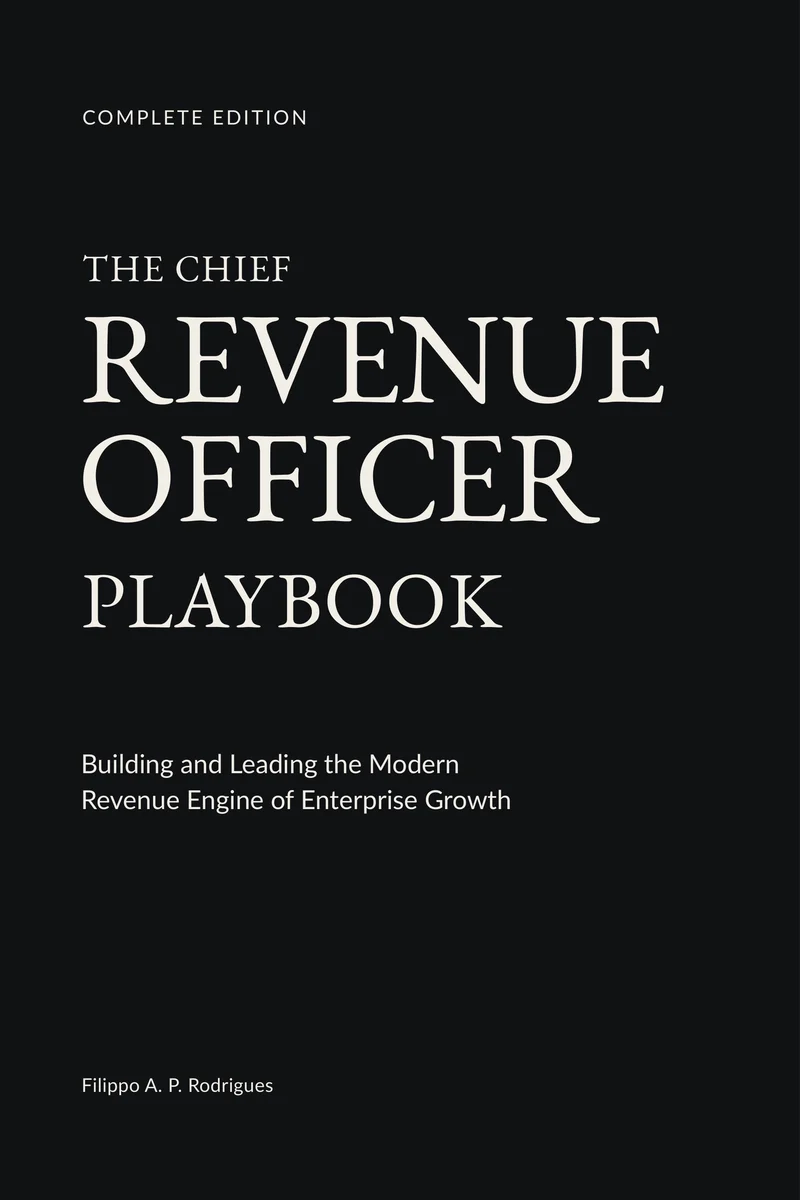
    Cover of The Chief Revenue Officer Playbook, Complete Edition

    Complete Edition

    Sections 1 to 22, chapters 1 to 157. 1,335 pages.

    The entire argument in one book, from the CRO mandate to board authorization of an enterprise revenue transformation. The best choice if you lead, or intend to lead, the whole engine.

    Buy the Complete Edition on Amazon
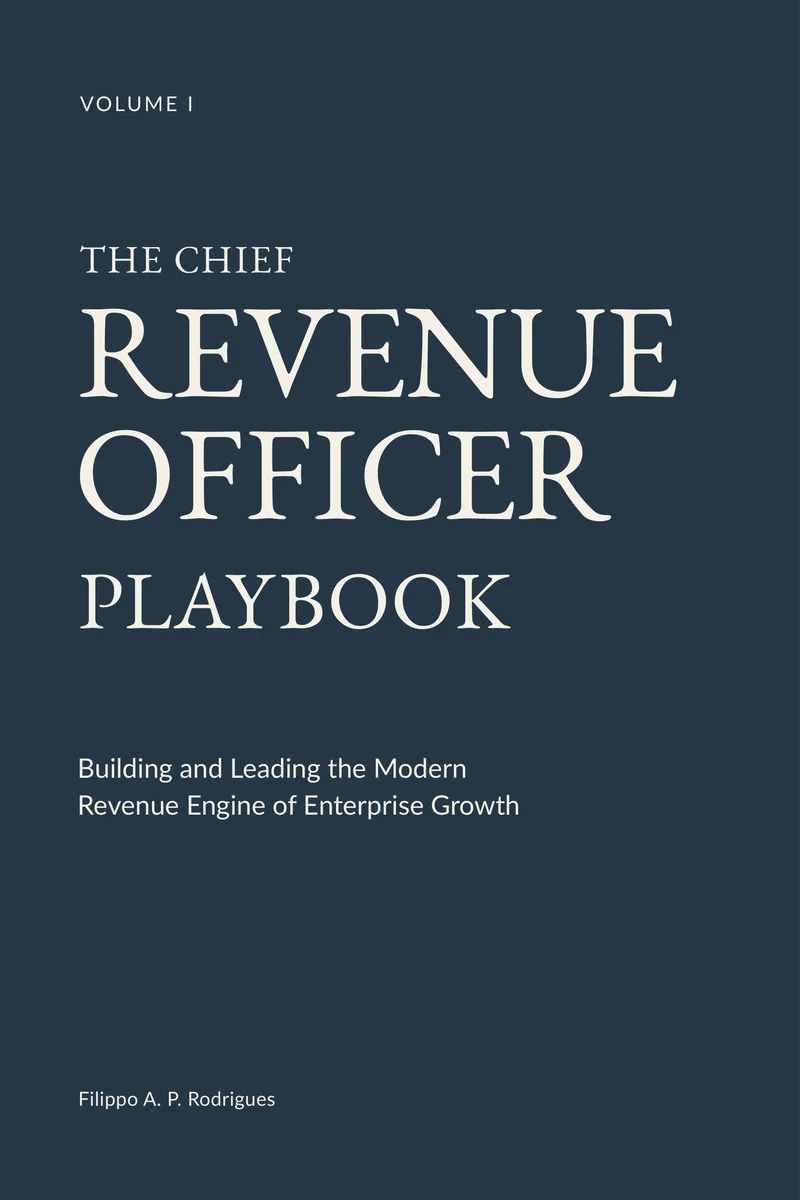
    Cover of Volume I

    Volume I

    Sections 1 to 8, chapters 1 to 47. 426 pages.

    The mandate and the economics of growth: enterprise value, corporate scope, scaling, markets, customers, demand and product.

    Buy Volume I
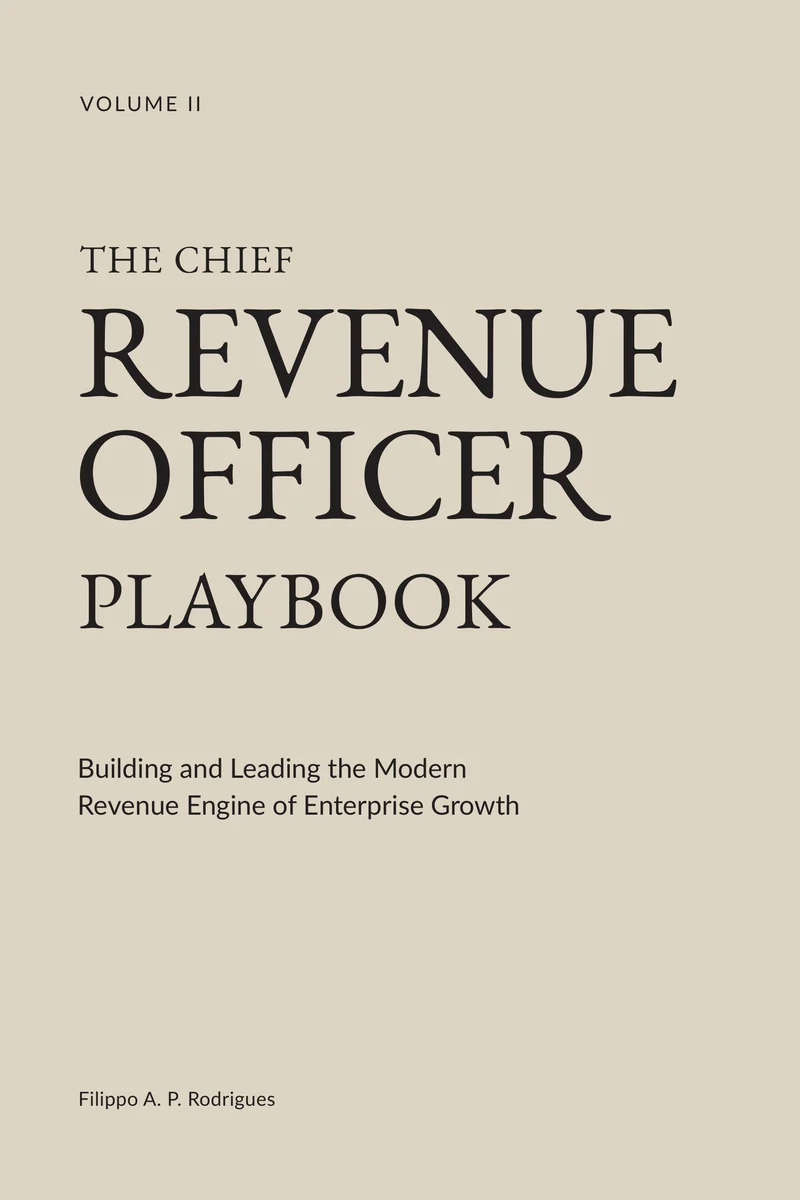
    Cover of Volume II

    Volume II

    Sections 9 to 15, chapters 48 to 99. 465 pages.

    How the offer becomes a relationship: revenue science, pricing, go-to-market, compensation, enterprise selling, negotiation and customer success.

    Buy Volume II
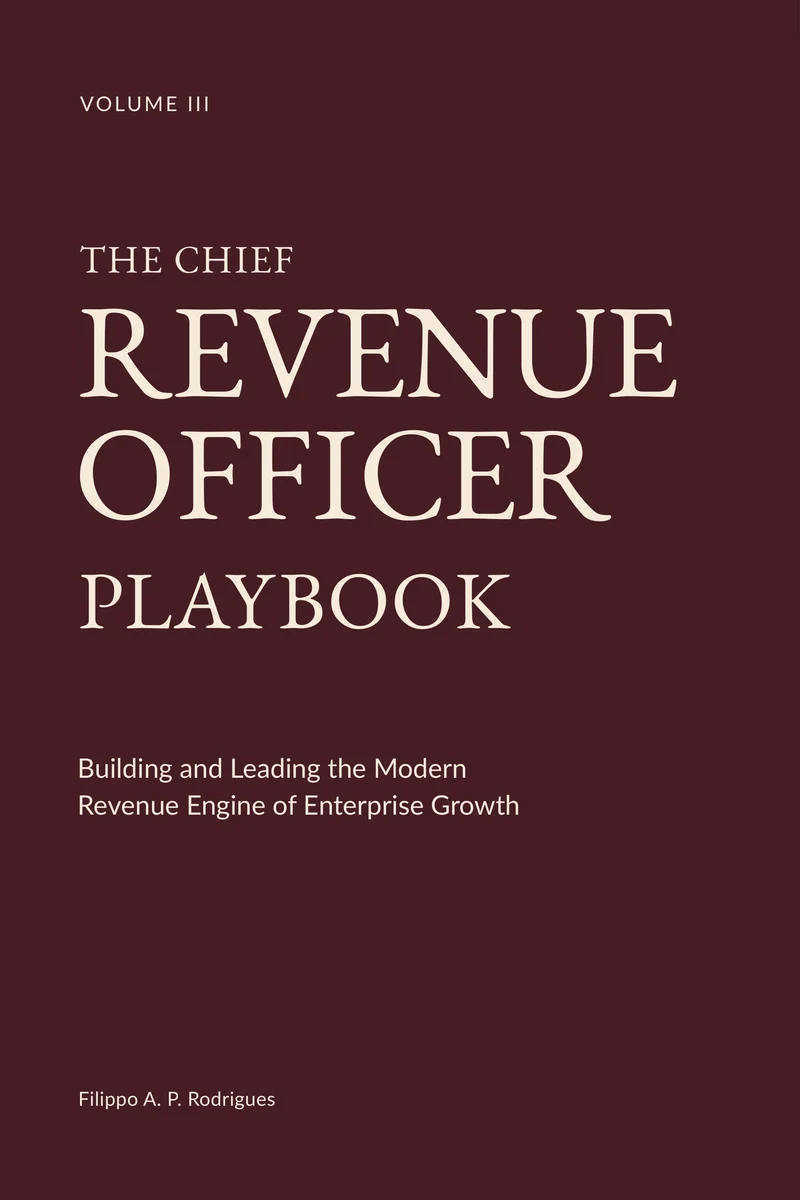
    Cover of Volume III

    Volume III

    Sections 16 to 22, chapters 100 to 157. 497 pages.

    Governing at scale: revenue operations, AI, commercial finance, alliances, leadership, the board and enterprise transformation.

    Buy Volume III

    Built on evidence, not slogans

    The book brings together management research, economics, public company filings and practical experience. It cites more than 650 sources and separates what a documented case shows from what it cannot prove. Frameworks have to earn their place by changing a decision.

    Each section opens with a thinker whose question it takes up:

    • Russell L. Ackoff
    • Aswath Damodaran
    • Ronald H. Coase
    • Edith Penrose
    • Theodore Levitt
    • David R. Bell
    • Claude C. Hopkins
    • Herbert A. Simon
    • Daniel McFadden
    • Hermann Simon
    • Jay R. Galbraith
    • Steven Kerr
    • Neil Rackham
    • Mary Parker Follett
    • Eva Ascarza
    • Rob J. Hyndman
    • Douglas C. Engelbart
    • Oliver Hart
    • Ron Adner
    • Chester I. Barnard
    • Aristotle
    • W. Edwards Deming

    About the author

    Filippo Rodrigues

    Filippo Andrade Prins RodriguesAuthor of The Chief Revenue Officer Playbook

    Filippo holds an MSc in Management, with an emphasis on Strategy and Innovation, and has two decades of experience in competitive strategy across several industries.

    His work spans commercial transformation, business development, internationalization, mergers and acquisitions, strategic alliances, market expansion and new revenue streams, most of it in initiatives whose results depend on several functions and partners working together.

    He has contributed to initiatives associated with billions of dollars in revenue streams and commercial opportunities.

    The book is the result of a long-term project developed over many years of research, study and professional practice, bringing scientific research, management theory, empirical evidence and experience into one account of how enterprise revenue systems work.

    For consulting, training and speaking, send a request. For corporate orders and interviews, write to contato@filippoandrade.com.

    Bring the playbook into your company

    Filippo works with leadership teams that need their revenue engine to hold together, from the first diagnosis to a plan the board can authorize.

    Consulting

    Engagements scoped to the decision in front of you, from a focused diagnosis to a transformation program.

    • Revenue engine diagnosis
    • Growth thesis and a board-ready plan
    • Pricing and monetization
    • Go-to-market design and strategic alliances

    Prefer email? contato@filippoandrade.com

    I'm interested in

    Your request goes straight to Filippo by email.

    Questions readers ask

    Is this a sales book?

    No. Selling is one essential part of the system the book describes. So are customer value, strategy, product, pricing, demand, delivery, finance and leadership. The book is about making their decisions compatible.

    Is it only for software or SaaS companies?

    No. Many examples come from industrial equipment and services, and the book addresses manufacturers, distributors, retailers, financial institutions and service businesses alongside subscription and platform models. It is explicit that there is no single formula for growth.

    Do I need a finance background?

    No, but expect to work through numbers. Valuation, return on capital, unit economics and deal economics are developed step by step, with worked examples that explain what each calculation can and cannot tell you.

    Should I buy the Complete Edition or a volume?

    Buy the Complete Edition if you are responsible for growth across functions or want the full reference on your shelf. Choose a single volume if you need to go deep on one part of the engine now: Volume I for strategy and economics, Volume II for pricing, selling and customers, Volume III for operations, finance, AI and leadership.

    Does it cover AI?

    Yes. Section 17 covers where AI changes revenue work, how to redesign human and AI workflows, search and agent-mediated discovery, how to measure AI productivity, responsible AI and agentic commerce.

    Can my company buy copies for a leadership team?

    Yes. Write to contato@filippoandrade.com with the number of copies and the edition you need. If you would also like a workshop or a talk for the team, send a request.

    See the whole engine.

    The Chief Revenue Officer Playbook is available on Amazon in a Complete Edition and three volumes.